
The 2026 midterm election cycle is taking place amid unprecedented federal interference, mounting legal uncertainty, widespread election disinformation, and ongoing attacks on the people and systems that run our elections. At the same time, election officials across the country are doing heroic work to ensure safe and secure elections, and pro-democracy partners are ready to defend our democracy.
Our Election Hub provides a trusted source of key resources for voters and advocates to protect elections.
Featured
Voting Toolkit: How Can I Protect the Elections?
This toolkit is provided as a service to partner organizations who are looking to provide their members and stakeholders with trusted, vetted information about how they can engage in elections to protect and defend our democracy.
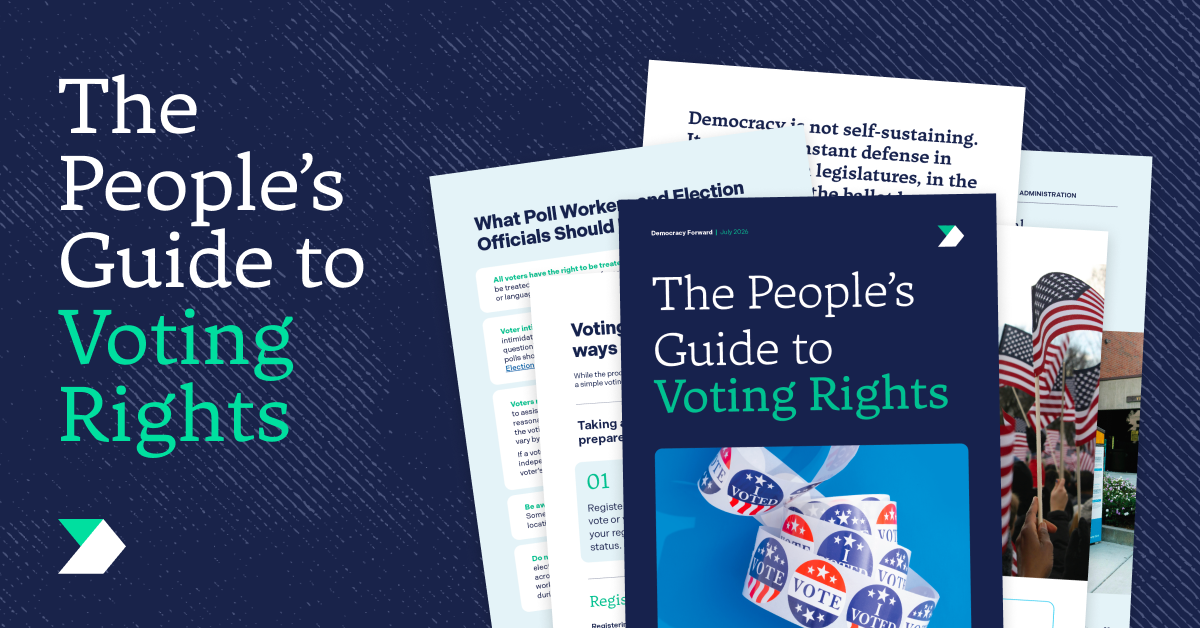
The People’s Guide to Voting Rights
This guide covers the voting landscape of the 2026 midterm elections and informs voters about their rights and options.
Resources
Resources for Voters
Take Action
- Make a plan to vote: vote411.org (Vote411)
- Learn how to engage: Democracy Forward’s 100 Days of Action (Democracy Forward)
- Mobilize: Freedom Summer (Black Power War Room)
- Volunteer: Ground Control Hub (Ground Control)
- Sign up to be a poll worker: Power the Polls (Power the Polls)
- Post on social media: 866 Our Vote Election Protection (Election Protection)
Informational Resources for Voters
- Juneteenth Mobilization Guide & Preparing to Vote (Democracy Forward)
- Vote Safely in 2026 (Asian Americans Advancing Justice | AAJC, Brennan Center for Justice, Fair Immigration Reform Movement, UnidosUS)
- Preventing Voter Intimidation by Federal Agents at the Polls (Brennan Center for Justice)
- Your Vote Is Precious — And Protected (Asian Americans Advancing Justice | AAJC)
Resources For Partner Organizations
- Partner Voting Toolkit: How Can I Protect the Elections? (Democracy 2025)
- Note: includes a version with space for partner co-branding.
- Nonprofit Civic Engagement & Voter Registration Activities in 2026 (Democracy 2025)
- Host a Voter Registration Drive (Fair Elections Center)
- Midterm Election Hub – Guidance on compliance issues (Alliance for Justice)
- Defending Democracy at the Ballot Box: A Small Business Owner’s Toolkit for Protecting the Midterm Elections (Protect Democracy, Integrity Matters)
- Polling Hub: What Americans Think About Elections, Democracy, and the Rule of Law (States United Democracy Center)
- What’s Breaking Through About Deploying Federal Agents to Polling Places (States United Democracy Center)
- What’s Breaking Through About Public Safety at Polling Places (States United Democracy Center)
- Rapid Response Grants – Grants are available from Impact Fund to support election litigation (Impact Fund)
- Community Resilience in the 2026 Elections (Protect Democracy, Over Zero)
- Spanish: Resiliencia Comunitaria en Las Elecciones de 2026 (Protect Democracy, Over Zero)
Resources for Attorneys to Volunteer
- 2026 Guide to Voter Protection Opportunities for Lawyers (We the Action)
- Volunteer with the Poll Monitoring Program (Election Protection)
- Volunteer with Election Protection Hotlines (Election Protection)
Resources for Litigators
Below are examples of party filings and court orders in cases involving election risks. These are designed as a resource to litigators who may be preparing to litigate similar issues around the 2026 election. Stay tuned for new examples to be added. If you are aware of other cases with particularly helpful example filings that should be highlighted here, please reach out to democracy2025@democracyforward.org.
Example Filings: Seizure of Election Materials
In re: Grand Jury Subpoena, 1:25-cv-02777 (N.D. Ga)
In this 2026 case, the Fulton County Board of Registration and Elections moved to quash a U.S. Department of Justice (DOJ) grand jury subpoena seeking the names, addresses, and phone numbers of thousands of election workers and volunteers from the 2020 election, arguing the subpoena was politically motivated, overbroad, and untethered to any legitimate prosecutorial need. The court granted the motion to quash, finding that the statute of limitations had expired and that the burden on the county substantially outweighed DOJ’s minimal need for the information.
Key filings:
- Motion filed by Fulton County to quash the grand jury subpoena seeking the personal information of Fulton County’s election staff and volunteers in the 2020 election
- Order granting a stay of enforcement of the subpoena
- Motion filed by Fulton County to unseal docket
- Order granting motion to unseal the docket
- Order granting motion to quash grand jury subpoena
Pitts v. United States, 1:26-cv-00809 (N.D.Ga)
In this 2026 case, after the DOJ seized records related to the 2020 election from Fulton County, Georgia pursuant to a search warrant, Fulton County officials and others sought the return of those records, arguing that the seizure violated their Fourth Amendment rights. A journalist separately successfully intervened to unseal the search warrant and docket. The court denied the motion for return of property, allowing DOJ to retain the seized materials.
Key filings:
- Motion for Return of Property (seized ballots and election materials) pursuant to Federal Rule of Criminal Procedure 41(g) and Memorandum of Law in Support
- Motion to Unseal filed by Fulton County to unseal the affidavit
- Motion filed by a journalist seeking to intervene and unseal court records
- Order directing government to unseal the docket and file the search warrant
- Amended Motion for Return of Property
- Reply in Support of Amended Motion for Return of Property
- Order denying motion for return of property finding the county failed to show that its constitutional rights were “callously disregarded.” Despite the adverse ruling, the court did note that the warrant application’s affidavit was “defective in some respects” and flagged several of its features as “troubling” and “problematic.”
Educational Resources
These resources discuss considerations for courts as they evaluate election-related search warrant requests. They may be helpful tools for litigators as well.
- A Judicial Guide to Search Warrants Seeking Election Materials (UCLA School of Law Safeguarding Democracy Project)
- Election Law Information Resources (UC Berkeley Law Edley Center on Law & Democracy)
Example Filings: Voter Intimidation
CAIR Minnesota v. Atlas Aegis, 0:20-cv-02195 (D. Minn.)
In October 2020, Atlas Aegis, LLC, a private security firm, posted advertisements seeking to hire former special operations forces members as armed security to “protect” polling places, residents, and businesses in Minnesota from purported “Antifa” looting and destruction. In this case, the plaintiffs alleged that this recruitment effort amounted to voter intimidation under Section 11(b) of the Voting Rights Act of 1965 and sought injunctive relief. The court granted a preliminary injunction, barring Atlas Aegis from deploying armed agents within 2,500 feet of Minnesota polling places or otherwise monitoring them during early voting and on Election Day, threatening to deploy armed agents to polling places, and otherwise intimidating, threatening, or coercing voters. The court subsequently approved a consent decree in which Atlas Aegis agreed not to deploy armed agents at election sites, or otherwise intimidate, threaten, or coerce voters, persons aiding voters, or persons engaged in tabulating, counting, or reporting votes in Minnesota.
Key filings:
- Complaint
- Motion for Temporary Restraining Order (TRO) and Preliminary Injunction (PI)
- Order granting preliminary injunction
- Consent Decree proposed by parties
- Order approving the parties’ consent decree, in which Atlas Aegis agreed not to deploy armed agents at election sites, or otherwise intimidate, threaten, or coerce voters, persons aiding voters, or persons engaged in tabulating, counting, or reporting votes in Minnesota, among other provisions
Arizona Alliance for Retired Americans v. Jennings, 2:22-cv-01823 (D. Ariz.), consolidated with League of Women Voters of Arizona v. Lions of Liberty LLC, 3:22-cv-01823 (D. Ariz.).
These two cases arose out of efforts by multiple private individuals and entities to organize armed “drop box watchers” during Arizona’s 2022 general election. Both sets of plaintiffs alleged that the defendants’ surveillance, photography, recording of voters, and threats to publicize voters’ identities constituted unlawful voter intimidation in violation of Section 11(b) of the Voting Rights Act and 42 U.S.C. § 1985(3) (the Ku Klux Klan Act). Preliminary relief was denied in the Arizona Alliance for Retired Americans (AARA) v. Jennings case, but ultimately granted in the League of Women Voters of Arizona (LWV of AZ) case. After a hearing in court on plaintiff LWV of AZ’s request for a TRO, the court entered the order (which was in part stipulated to by the parties, and in part contested by defendants). The order prohibited the defendants from coming within 75 feet of ballot drop boxes to monitor voters, following or confronting voters, openly carrying firearms within 250 feet of drop boxes, posting voters’ personal information online, and making false statements about the legality of ballot collection.
Key filings:
- AARA v. Jennings:
- Complaint in AARA v. Jennings
- Motion for TRO and PI
- Order denying motion for TRO and PI because the court found that the AARA plaintiffs failed to show that they were likely to succeed on the merits.
- LWV of AZ v. Lions of Liberty, LLC:
- Complaint in LWV of AZ v. Lions of Liberty, LLC
- Motion for TRO and PI and primary brief in support of motion
- Supplemental brief in support of motion for TRO and PI
- Transcript of hearing, Nov. 1, 2022 (including verbal ruling on TRO, pages 182-191)
- Order granting LWV of AZ plaintiffs’ motion for TRO
National Coalition on Black Civic Participation v. Wohl, 1:20-cv-08668 (S.D. New York)
This case challenged a coordinated voter intimidation campaign that was conducted prior to the 2020 election. The plaintiffs alleged that defendants Jacob Wohl, Jack Burkman, and affiliated organizations, targeted predominantly Black voters with robocalls falsely claiming that voting by mail would expose recipients’ personal information to law enforcement, debt collectors, and the Centers for Disease Control and Prevention (CDC) for “mandatory vaccinations.” The complaint asserted violations of Section 11(b) of the Voting Rights Act, 42 U.S.C. § 1985(3) (the Ku Klux Klan Act of 1871), and New York civil rights laws. After the court granted summary judgment for plaintiffs, the case concluded with a consent decree imposing monetary relief as well as injunctive relief prohibiting defendants from engaging in future voter intimidation or disseminating materially false information intended to interfere with voting, and allowing the court to retain jurisdiction to enforce the agreement.
Key filings:
- Private plaintiffs’ complaint alleging that defendants intimidated, threatened, or coerced persons for voting or attempting to vote in violation of Section 11(b) of the Voting Rights Act (52 U.S.C. § 10307(b)), and a conspiracy to deprive Black voters of the equal protection of the laws by interfering with their right to vote in violation of 42 U.S.C. § 1985(3)
- Private plaintiffs’ Motion for TRO and PI
- Order granting private plaintiffs’ motion for TRO
- Request to intervene filed by New York Attorney General (NYAG) on behalf of plaintiffs
- Order granting intervention
- Complaint in intervention filed by NYAG
- Private plaintiffs’ amended complaint
- All plaintiffs’ joint Motion for Summary Judgment
- Order granting summary judgment for all plaintiffs, ruling that defendants violated Section 11(b) of the Voting Rights Act, the Ku Klux Klan Act, and New York civil rights law
- Consent Decree providing monetary and permanent injunctive relief
Additional Election Resources from Democracy Forward
- Nonpartisan Election Official Preparedness Compilation (Democracy 2025)
- Explainers: DHS’s Unreliable SAVE System Can no Longer be Used to Purge Voter Rolls (Democracy Forward Foundation, Democracy 2025, CREW, Fair Elections Center, EPIC, and League of Women Voters)
- Exposing and Disrupting Federal Attempts to Interfere in the 2026 Midterm Elections (Democracy Forward)
- Dinners For Democracy Voting Discussion Guide (Democracy Forward)
- Red Line for Civil Rights Voting Page (Red Line for Civil Rights)
- Ways to Support Voting Rights (Ordinary People, Extraordinary Times)
Webinars
Democracy 2025’s Election Briefing Series
The Democracy 2025 Election Briefing Series provides accessible information about emerging threats to our elections, helps partners navigate a rapidly evolving landscape, and identifies concrete ways to get involved to protect our elections. Developed in collaboration with leading experts in the pro-democracy ecosystem, the series brings together diverse perspectives and offers practical guidance for organizations working to protect our democracy.
Topics for the briefings include:
- The Authoritarian Elections Playbook;
- Elections and Weaponized Immigration Enforcement;
- How Nonprofits Can Participate in Nonpartisan Voter Engagement;
- Elections and Weaponized Immigration Enforcement;
- Elections Communications & Narrative Setting;
- Understanding DOJ Election Monitoring, Past and Present; and
- Protecting Access to the Ballot: Legal Responses to ICE at the Polls.